
Creek County VINELink Coverage
OK VINE is Oklahoma's free, confidential custody-status and notification service. Official state material describes anonymous status checks by phone, web, and the VINELink app, with alerts available through channels offered by the live service. Reported custody changes can include release, transfer, escape, apprehension, and death. The service is available around the clock at 1-877-654-8463.
Creek County's link is unusually direct. Sheriff Bret Bowling's current inmate search tells a user whose name is missing to try VINE because the person may have been released or transferred. State material also describes an enhanced connection between county-jail and ODOC movements through a single registration. That does not mean every old Creek County booking remains searchable forever, nor does it turn VINE into a full county release archive.
Coverage follows the reporting agency. Creek County Jail events and Oklahoma Department of Corrections movements may be reported through the state service. A federal BOP inmate requires the BOP locator. A municipal, juvenile, or other restricted record may need direct agency contact under its own access rules.
The same name can move through more than one system. A Creek County booking may end with a transfer to ODOC, and the state corrections agency may then become the useful reporting source. VINE can help track that movement, but the county jail register remains the source for how the local booking ended. ODOC records control the later prison or supervision status.
Search Creek County VINELink Records
Use the direct Oklahoma VINELink person search for one named individual. A broad name match is only the start. The reporting agency and available identity details must align with the person connected to Creek County before the status is treated as relevant.
- Open the Oklahoma person search so the state scope is set correctly.
- Enter the full name or an available identifying number. Try a careful name variation if the first search fails.
- Compare age, agency, and other displayed identifiers to rule out namesakes.
- Open the matching record and note the reporting agency before reading custody status.
- If the result reports release, record the event and date exactly as shown.
- If it reports transfer, identify the destination system and continue there.
- If the result is missing or unclear, call VINE or the originating agency rather than treating absence as proof.
The live search interface appears in this manifest capture from the official Oklahoma VINELink source.
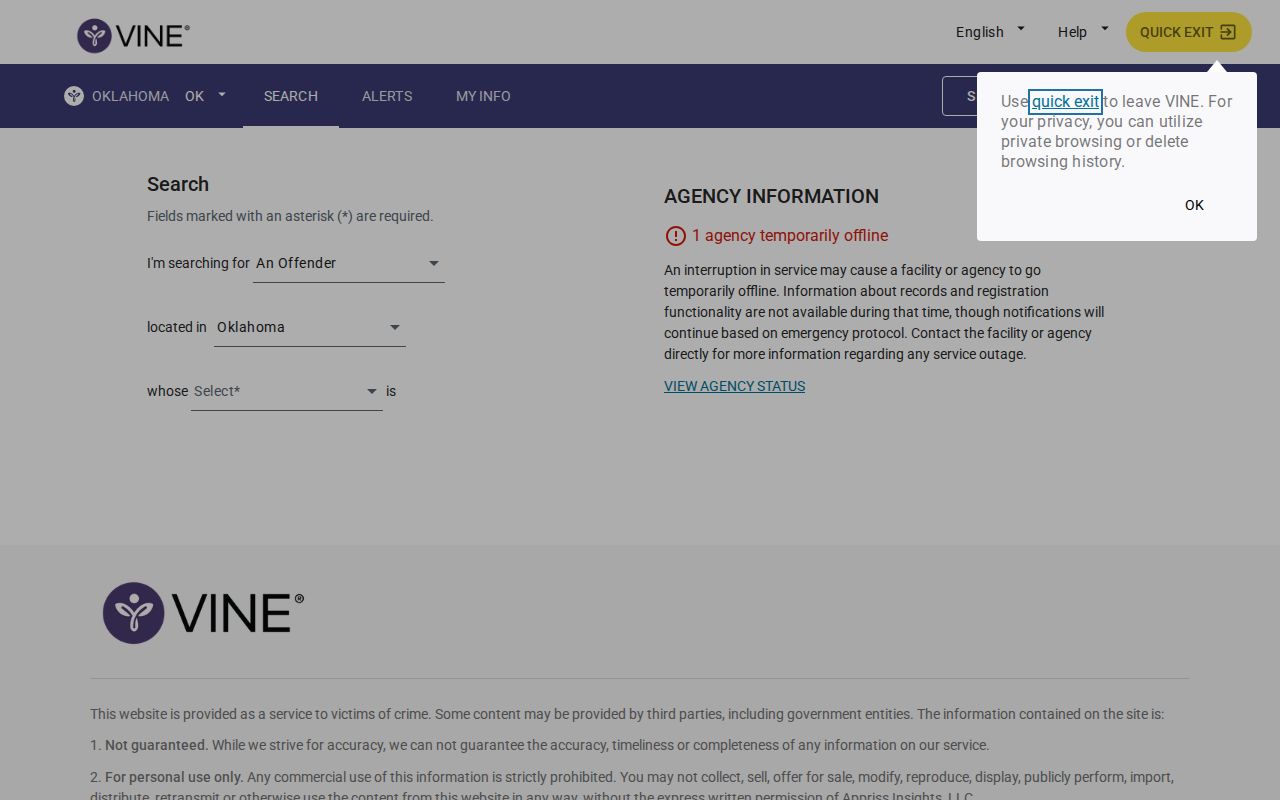
The state-specific screen keeps the search focused, while the result's agency and status determine what the record actually confirms.
Note: Match the agency and identity before registering, since an alert for a namesake will not answer the Creek County custody question.
Creek County VINELink Release Fields
VINELink is built around a custody record and its notification options. Exact labels can change with the live interface, so they should be transcribed from the matching record instead of replaced with older wording. A released result means the reporting agency transmitted a release or custody-change event. It does not supply every legal consequence of that event.
| Field or element | What it tells the reader |
|---|---|
| Name or ID | The search identity used to locate the record. |
| Age and identifiers | Available facts used to separate people with similar names. |
| Reporting agency | The county, state, or participating authority that supplied the event. |
| Custody status | The exact state of custody reported by that agency. |
| Release or event date | The displayed timing of a transmitted custody change when available. |
| Notification control | The route to register for available phone, text, email, app, or TTY notices. |
A release event does not prove dismissal, full sentence discharge, the end of parole or probation, or the absence of another detainer. A transfer is even narrower. It means one agency's custody changed while another placement may continue.
Facility or location wording should also be read as an agency status, not a promise that the person is at the same place at the moment of the search. When the event is recent, compare the result with the Creek County daily or weekly report. For an ODOC person, open the state offender lookup and reconcile the court, sentence, facility, and supervision details before drawing a conclusion.
Register Creek County Release Alerts
Register only after opening the verified matching person. Oklahoma describes registration as confidential, while status checking may be anonymous. The live record controls which contact methods are offered and what confirmation is required. Button names can change, so follow the current Register or Get Notifications control.
- Open the correct Creek County or ODOC record and choose the notification-registration option.
- Select an offered channel, such as telephone, text, email, in-app message, or TTY.
- Enter the destination carefully and review the person and reporting agency again.
- Create or enter a telephone PIN when prompted. Keep it for call confirmation or repeat-call management.
- Complete any email, text, or app confirmation required by the live service.
- Keep contact details current and use VINE support to test or manage the registration when needed.
Notifications can report more than community release. A transfer, escape, apprehension, or death may also trigger a message. Read the event type before acting on it. When a transfer is reported, search the destination agency instead of saying the person is free.
Note: Use the PIN or confirmation method shown by the live service; no fixed PIN length should be assumed.
Creek Roster-to-VINE Handoff
The Creek County current roster is explicit about its own limit. It covers people currently in custody and sends a no-result user to VINE for a possible release or transfer. It also publishes the state number, 1-877-654-8463. This local handoff is more useful than a generic VINE referral because it defines the next check after a person drops from the county roster.
A missing roster card is not a release record. The system may be updating, the person may have transferred, or the name may not match the current entry. VINE adds a separate participating-agency status check. If it shows a Creek County release event, compare that result with the sheriff's daily or weekly Released timestamp. If it shows transfer, use ODOC or the named destination.
The final county proof is the jail-register entry with date and manner of discharge. That manner can separate bond or completion from a transfer to another authority. VINELink supplies a timely bridge, while the originating agency supplies the durable record.
Creek County's rolling reports can add an exact Released time while a recent booking remains visible. That timestamp and a VINE event can support each other, yet they still answer only the county booking question. If the jail register records a transfer, continue with the destination agency rather than treating two matching events as proof of community release.
Creek County Parole Notice Layer
OK VINE custody alerts do not replace every victim-notification program. The Oklahoma Pardon and Parole Board VINE page explains a separate victim-services layer, and the Board provides a written notification form for parole-hearing and release-to-parole notices. A person who needs that type of notice should not assume a county-jail VINELink registration automatically completes the PPB process.
This distinction also protects the meaning of a parole event. A hearing date or favorable Board result is not the physical release date. Conditions, final action, and processing can remain. ODOC status, VINE, the assigned probation and parole office, or discharge documentation should be checked for the actual post-prison position.
The Oklahoma Pardon and Parole Board is separate from both Creek County and ODOC. Its notice process focuses on parole proceedings and release-to-parole information for registered victims. VINELink focuses on custody events reported through participating systems. Keeping both registrations current may be necessary when both kinds of notice apply, because one program does not promise to deliver the full notice set of the other.
- Custody alert
- A notice that a participating agency reported a change such as release or transfer.
- Parole
- Conditional community release from a state prison term under supervision.
- Discharge
- Completion or formal end of the correctional status shown by the responsible agency.
- Detainer
- A request or authority that can send a person to another agency after one custody ends.
Confirm Creek County VINELink Results
VINELink does not cover every possible Creek County outcome. It is not the federal BOP locator, a court disposition database, a county release archive, or proof that all supervision ended. Data can also lag the physical event. A result should be paired with the source that controls the custody type.
A county bond release may never create an ODOC record. A Creek County transfer after a state sentence can make ODOC the main status source. A BOP result applies only to federal custody, and an ICE no-result does not prove release. Court dockets can explain bond, dismissal, judgment, or revocation, but they usually do not establish the exact time jail staff completed an exit.
| Person or event | Primary check | Best confirmation |
|---|---|---|
| Recent Creek County Jail exit | VINE and sheriff booking report | Jail-register date and manner of discharge |
| Transfer to Oklahoma corrections | ODOC offender lookup | ODOC status or discharge documentation |
| Federal person | BOP inmate locator | BOP record and federal case source |
| Possible immigration handoff | County manner of discharge and ICE locator | ICE assistance or agency records |
| Court case outcome | ODCR or OSCN docket | Correct Creek County Court Clerk division |
The Creek County released-inmate lookup supplies the broader source path when VINE identifies an event but not the full county, state, court, or federal context.
Note: State the result by system, such as released from Creek County Jail or discharged from ODOC, rather than “free from custody.”