
Creek Release Dates by Custody
Start with the agency that controls the sentence. Creek County Jail holds local pretrial detainees and people serving or awaiting action on local matters. ODOC controls state prison terms and related state supervision records. BOP controls federal prison records. A date taken from one system should not be applied to another.
A pretrial detainee usually has no calculated sentence end. Release can depend on bond, a court order, dismissal, transfer, or later judgment. A locally sentenced person may have credited jail time, but research found no published Creek County jail good-time or weekend-release policy. Ask for the commitment or order and confirm the calculation with Sheriff Bret Bowling’s jail staff and the court. Do not run an ODOC formula against a local stay.
| Custody setting | First date source | Main limit |
|---|---|---|
| Creek pretrial detention | Creek court and jail | No fixed date may exist |
| Creek local sentence | Commitment, court, and jail records | Local calculation is not the ODOC credit schedule |
| Oklahoma state sentence | ODOC offender and sentence records | Future date can be confidential and tentative |
| Federal sentence | BOP locator and records | BOP exit does not rule out another hold |
Note: A transfer closes one facility’s custody but may place the person in another jail, prison, federal, or immigration system.
Creek Scheduled and Actual Release
Oklahoma’s Pardon and Parole Board glossary defines Projected Release Date, or PRD, as ODOC’s estimate of a prison release date. ODOC calculates it. The Board does not. Credits can move the estimate earlier, while misconduct and lost credits can move it later. Court corrections, sentence sequence, and statutory restrictions can also change it.
Parole eligibility is another date. It marks when a case may be considered under the governing law, not when release must occur. A favorable parole result may still require conditions, processing, or other action. Conversely, a sentence-based release can occur without parole. Keep the PRD, eligibility date, Board decision, and actual discharge in separate notes.
An actual Creek County jail release may appear as a Released timestamp in a short-window booking report. That timestamp only closes that Creek booking. The jail-register “manner of discharge” is needed to tell whether the person went to the community or another authority.
Find a Creek Inmate Release Date
Follow the custody chain before asking for a calculation. Search exact names and reconcile dates, county, court, sentence, and agency. A common name can produce a convincing but wrong state record.
- Check the Creek Sheriff’s current roster only for present county custody. If the person is missing, do not assume release.
- Review the official 24-hour and 72-hour booking reports for a recent Released timestamp. Those products are selected by booking time, so older bookings can be absent.
- Use the Creek court docket and correct clerk to identify bond, judgment, sentence, remand, dismissal, or revocation action. The docket does not prove the precise jail-door time.
- If the case became an Oklahoma state sentence, use the ODOC offender lookup. Match county, court, sentence, and ODOC number.
- When a future date is not public, use authorized ODOC channels. Ask for the days-remaining information from the incarcerated person when appropriate, or follow the agency’s records and victim-services process.
- After the expected event, verify it through updated ODOC status, OK VINE, the supervising office, or an official discharge record.
The Creek County released inmate search provides the full named-person route when the custody type is unknown. For federal incarceration, use the BOP locator rather than ODOC. For a possible ICE handoff, the ICE locator is mainly a current-custody check and a no-result is not proof of release.
Creek ODOC Future-Date Limits
The current ODOC Offender Information page says a particular inmate’s future release date is confidential without a legitimate need. It also says the inmate receives days remaining each month and any date is tentative. That official limit must lead a public lookup. Older references to an online projected release field do not justify promising that the current detail page shows one.
The captured ODOC information page below documents that future-date limitation and tentative-date guidance.
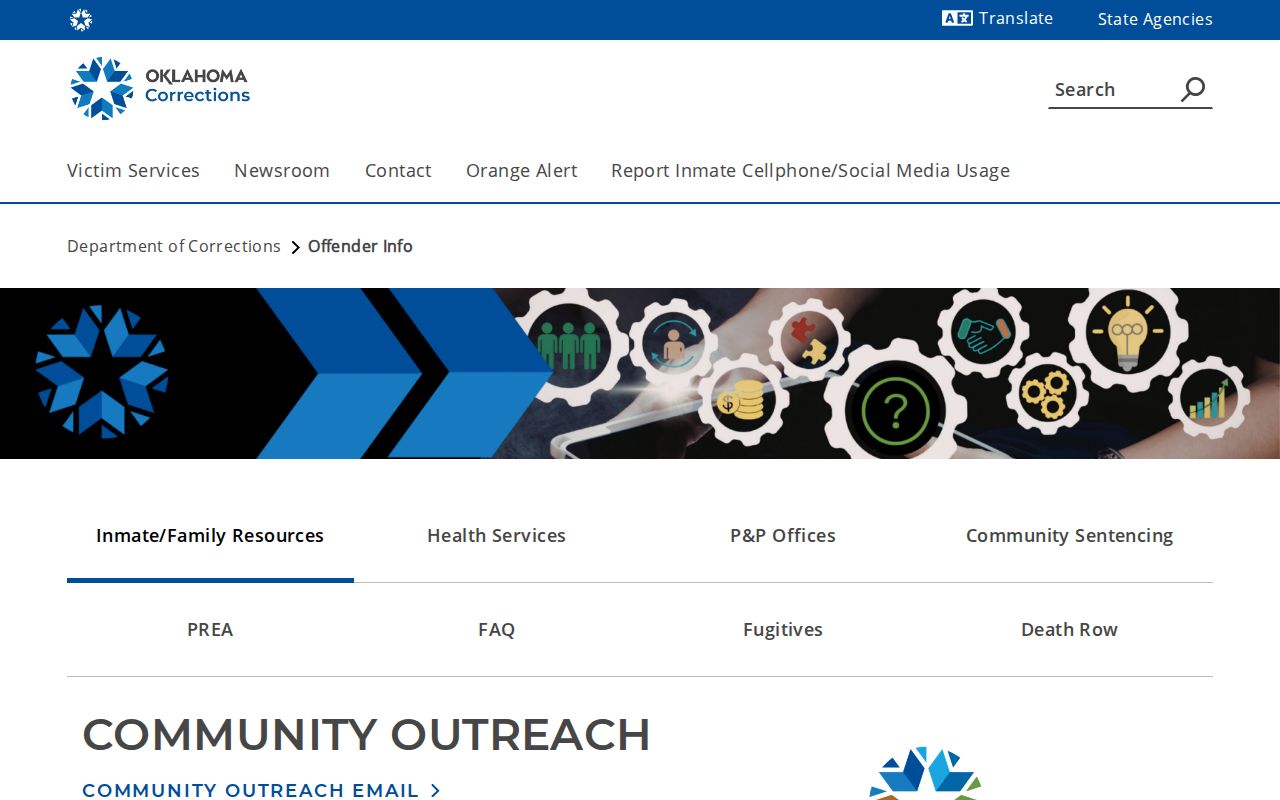
The screenshot supports a careful answer: public users can search the offender record, but access to the projected future date can require an authorized path.
ODOC’s lookup also carried a new-data-source warning during research. Treat abbreviated online information as a starting point. ODOC Legal Services lists Closed Records at 405-425-2691 and osordischarges@doc.ok.gov for discharges. Its authorization form may be required for nonpublic incarceration or supervision details.
Official ODOC descriptive material identifies search and detail points that can include name, ODOC number, appearance, facility, sentence, conviction date, court, CRF number, term code, statute, and statute code. Use those fields to confirm identity and sentence scope even when no future date appears. A community-supervision assignment may indicate parole or supervised probation, while an active institution points to state custody. Exact status labels should be transcribed from the current result rather than supplied from an old screenshot or memory.
Creek State Release Credit Rules
For ODOC sentences, 57 O.S. §138 supplies the earned-credit structure. One earned credit equals one day. The standard monthly class schedule is Class 1 with zero credits, Class 2 with 22, Class 3 with 33, and Class 4 with 44. The law also permits specified achievement credits.
Credits are earned under ODOC rules, not simply subtracted once at sentencing. Class level can change. Misconduct can result in credit loss after due process. Credits may be restored under stated criteria, but restoration is not guaranteed. ODOC tallies accumulated time monthly and reports it through its central process.
The calculation can be understood as a sequence:
- Identify sentence start or reception and the controlling sentence or sentences.
- Apply credited jail time and lawful concurrent or consecutive ordering.
- Subtract earned monthly credits and approved achievement credits.
- Add lost credit or apply an approved restoration when the record changes.
- Enforce statutory minimum service and other restrictions.
- Recalculate as class, credits, orders, and sentence data change.
Official ODOC policies OP-060107 and OP-060211 address earned credits and calculation or restoration. They are relevant to ODOC custody, not a pretrial Creek County stay.
Creek Release Date Statutory Floors
The 85-percent rule is a floor for offenses enumerated in 21 O.S. §13.1. It is not a formula for every Oklahoma sentence. A person convicted of a listed offense must serve at least 85 percent of the imposed imprisonment before parole, and credits cannot reduce actual service below that floor. The official statute has versioned offense lists, so the offense date and applicable text matter.
Do not reduce the rule to “all violent offenses.” That statement is too broad. It is also wrong to apply the state floor to all Creek jail bookings. Local pretrial release follows bond, court orders, holds, and jail processing. A short county sentence must be checked through its own judgment and credit record.
Parole eligibility under 57 O.S. §332.7 is separate and depends on crime date and category. Many offenses from July 1, 1998 through October 31, 2018 use a general one-third framework subject to exclusions. For many nonviolent offenses on or after November 1, 2018, the framework uses one-quarter, while listed, violent, and 85-percent cases face other rules. The full statute controls.
Note: Eligibility to be considered for parole does not promise a favorable vote, a release date, or the end of supervision.
Why Creek Release Dates Change
A useful date check records both the estimate and the source date. That makes later changes easier to explain. Some causes arise within ODOC. Others come from courts or outside agencies.
| Change | Effect on the estimate | Record to check |
|---|---|---|
| Class-level movement | Changes monthly credit rate | ODOC sentence and credit record |
| Achievement credit | May reduce remaining time | ODOC credit record |
| Misconduct or restoration | Can add back time or restore credit | ODOC disciplinary and credit record |
| Jail-credit correction | Changes time already credited | Judgment, court order, and ODOC record |
| Concurrent or consecutive correction | Changes how terms overlap or follow | Amended judgment and sentence record |
| Parole action | May create a different conditional path | PPB result and ODOC status |
| Detainer or hold | May change destination, not close all custody | Manner of discharge and destination system |
A court order can change the legal sentence while jail processing still takes time. A detainer can cause release to another agency. In both cases, the planned date and the person’s next location may differ.
Confirm Creek County Actual Release
After the anticipated date, check the actual event. OK VINE can report a release or transfer from a participating agency. A VINE release means that reporting agency ended its custody; it does not prove dismissal, complete discharge, or lack of another hold. The Creek County VINELink release check explains the one-person search and alert process.
For a parole case, compare the Oklahoma Pardon and Parole Board docket and result with ODOC. A scheduled hearing is not a decision, and a favorable action is not the physical release event. The Sapulpa Probation and Parole Office is the Creek County contact for available confirmation of an ODOC-supervised person. It should not be asked to calculate a county bond release or certify a local stay that never entered state supervision.
For a recent Creek booking, a populated Released timestamp can support the time that booking ended while the card remains online. Ask the Sheriff’s Records Division for the jail-register entry and its date and manner of discharge when durable proof is needed. For ODOC, obtain the updated status or discharge record. For BOP, read “Released” or “Not in BOP Custody” only as an end to BOP custody.
- Projected release date
- ODOC’s tentative estimate for the end of a prison term.
- Parole eligibility
- The point when a case may be considered under the applicable law.
- Actual release
- The completed exit from the named agency’s custody.
- Detainer
- A request or basis for another authority to take or keep custody.
- Discharge
- The formal end of a sentence or supervision record as confirmed by the responsible agency.
The safest conclusion always names the system: released from Creek County Jail, discharged from ODOC, or no longer in BOP custody.