
Creek County 72-Hour Release Check
Sheriff Bret Bowling's Creek County office publishes a 72-hour booking report. Its heading identifies a three-day booking span, and the official Media Resources page describes it as the weekly booking report. The product is not a release-selected feed. A booking card can show a Released date and time, but the person's booking must still fall within the rolling span.
This makes the report a useful short-term source for people who entered Creek County Jail recently and then left. Direct observation during the Creek research found populated Released fields in the report, which confirms the field is active. The counts seen at that moment were only a snapshot. They are not a stable release rate, a daily average, or a promise about how many cards will appear later.
Check Creek County 72-Hour Releases
Begin with the weekly report when the daily card has already disappeared or the likely booking occurred within the prior few days. Match more than a name. Booking photographs, birth dates, listed city, arresting agency, and charge data can help distinguish two people who share a name.
- Open the sheriff's 72-hour report and locate the most likely booking card.
- Confirm the booking date and time because that event controls the rolling window.
- Read the Released field. A populated date and time confirms the end of that listed Creek County booking.
- Compare the live inmate roster when current county custody remains in doubt.
- Use VINE if the card is absent, the roster no longer has the name, or a transfer may have occurred.
- Request the jail-register date and manner of discharge when the destination or official reason matters.
The shorter Released Last 24 Hours check is a faster same-day view, while the weekly report is the better first look for a booking that may have crossed more than one calendar day.
Note: A saved report preserves what was displayed, but the sheriff's jail-register entry is the stronger durable county source.
Creek County Three-Day Release Fields
The 72-hour cards carry the same basic fields as the daily report. The Released line has strong but narrow value. It shows the time a Creek County booking ended. It does not give the manner of discharge, destination, case disposition, or end of all supervision.
| Field | How to read it |
|---|---|
| Name and photograph | Identity clues tied to the booking, with a portrait where available. |
| Gender, race, birth date | Additional details for separating similar names. |
| Booking date and time | The event that determines entry into the 72-hour window. |
| Released date and time | Exit from that booking when the field is filled. |
| Arresting agency and address | Agency and listed residence details from the booking card. |
| Charges and total bond | Booking allegations and bond information, not the final result. |
| Court date | A future or listed court event that does not prove jail-door timing. |
This captured view comes from the official Creek County 72-hour report.
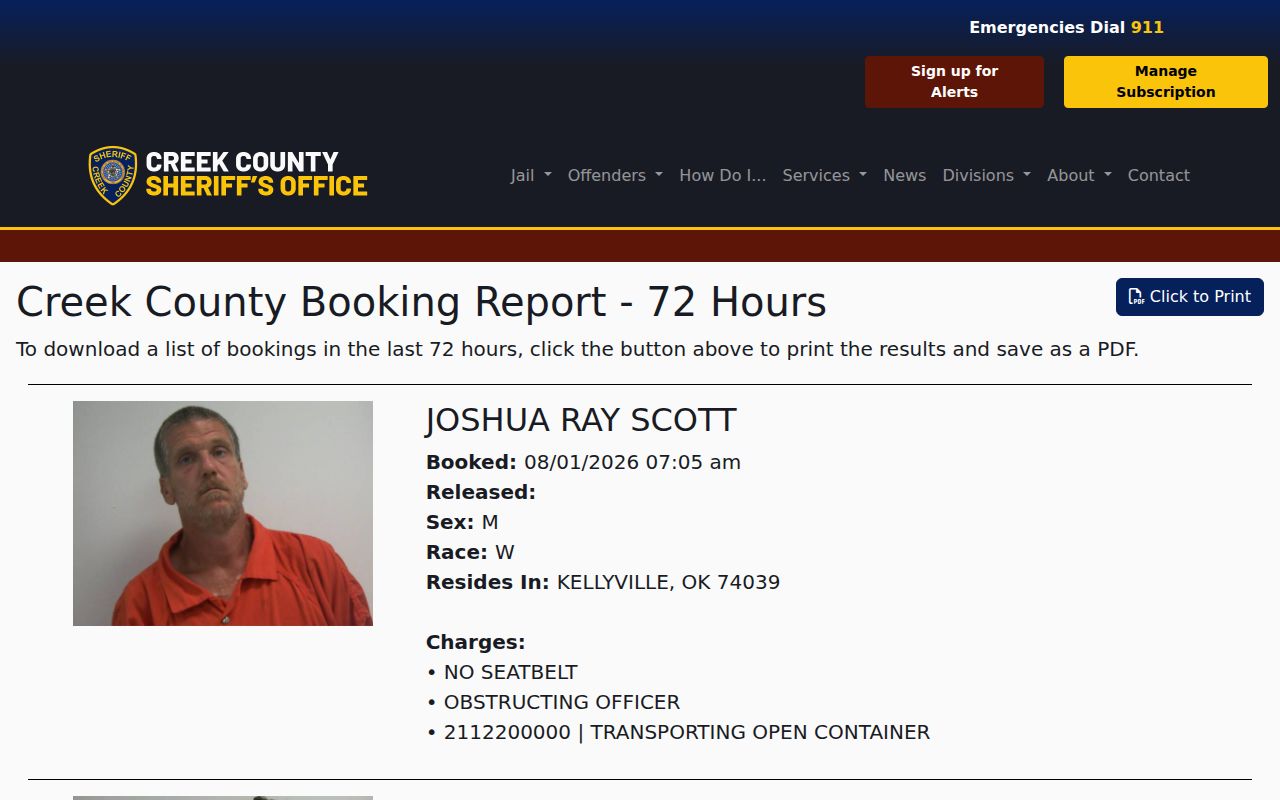
The report's layout puts booking facts and the Released timestamp together, so both should be checked before a release claim is made.
Creek County Weekend Release Span
A three-day view can bridge several days that the 24-hour page cannot. That can help after a weekend or holiday because a booking from an earlier calendar day may still be eligible for display. The benefit comes from the longer booking window, not from any verified special weekend release schedule. Creek County does not publish a separate holiday-release feed in the reviewed sources.
The reports also do not state their own refresh cadence. The sheriff describes the current roster as updated hourly, but that statement cannot be extended to the daily and weekly reports. A just-completed release may need time to appear. Check the Released line again, then use VINE or contact the jail if the timing matters.
Court activity and jail processing are also different events. A filed bond, dismissal, or court order can explain why custody may end, but it does not establish when staff finished release processing. The jail timestamp or register supplies the custody event. The court docket supplies legal context.
The longer display also helps when the exact booking day is uncertain. Search all cards that plausibly match, then compare the arresting agency and listed court date with the case record. A report that crosses several calendar days can reveal a short stay that has already fallen off the daily page. It still cannot show a long-held person whose original booking predates the three-day span.
Note: Use the longer span for multi-day catch-up, but do not infer a weekend timetable that the sheriff has not published.
Creek County Booking-Window Limits
Creek County's local data quirk is easy to miss: “daily” and “weekly” describe recent booking spans. They do not describe all release events in those spans. A person booked four days earlier can leave today and be absent from both products. A person booked within the past hour can appear with no Released time because custody continues.
The three-day product remains the more useful short-window check because each booking stays eligible longer. Yet it should never be relabeled as a complete list of people released in the last 72 hours. Online visibility ends as booking time ages out, and the sheriff does not publish a universal archive-retention period for the underlying release record.
A clean statement identifies the evidence: “the weekly report shows a Released time for this Creek County booking.” If the field is empty or the card is missing, the evidence does not support “still jailed” or “released.” Further checks are needed.
Creek County Release Fallback Chain
When the weekly card is gone, start with the custody type. For a Creek County Jail booking, VINE and the sheriff's record route are the closest follow-ups. The county roster itself directs a no-result user to VINE because release and transfer are both possible. VINE can show a custody event from a participating reporting agency, but absence is not proof.
Next, ask the Creek County Records Division for the person's booking or jail-register entry, including the date and manner of discharge. Supply the full name, birth date if known, and an approximate booking range. Requests may be emailed to info@creekcountysheriff.gov or made in person during the listed weekday office hours. The reviewed page states no fixed fee, universal turnaround, or dedicated form.
The manner is as important as the date. A date answers when Creek County stopped holding the person under that booking. The recorded manner can identify bond, court order, completion, transfer, escape, or another agency-coded outcome. Ask for destination or detainer information if it exists and is releasable, since the online booking card does not supply that field.
If the record says transfer to ODOC, search the Oklahoma offender lookup and match court, sentence, and identity details. ODOC is not an archive for people who only bonded out of the county jail. A federal person belongs in the BOP locator. A possible immigration handoff requires the county manner of discharge plus ICE checks. The correct system follows the destination.
For a named person whose history extends beyond the report, the Creek County released-inmate search reconciles the county, state, court, and federal paths without treating any one portal as universal.
Creek County Release or Transfer
A populated Released field means the person left that county booking. It does not always mean a return to the community. Possible outcomes include bond, court order, time served, transfer to ODOC, movement to another jail, or delivery to another agency. The online report lacks a release-reason field, so the next destination cannot be inferred from the timestamp.
| Source result | What it confirms | What it does not confirm |
|---|---|---|
| Weekly card with Released time | End of that Creek County booking | Community freedom or case dismissal |
| Current roster match | Present county custody as displayed | Final charge, bail, or sentence outcome |
| VINE transfer event | Custody movement reported by an agency | Release to the community |
| ODOC institution record | State corrections custody | County-jail detention |
Ask for the jail-register manner of discharge when that distinction matters. Narrow wording protects the accuracy of the result: released from Creek County Jail, transferred to ODOC, discharged from state corrections, and not in federal custody are separate findings.
Note: Court records can explain a legal event, but the jail record remains the best source for the actual county custody exit.